How to Become an Energy Advisor
Becoming an Energy Advisor (EA) in Canada involves meeting specific training, testing, and registration requirements established by Natural Resources Canada (NRCan). Here’s a step-by-step overview:
Familiarize yourself with what EAs do, including:
- Conducting home energy assessments
- Using diagnostic tools (e.g., blower door test)
- Modeling energy performance with HOT2000
- Advising on energy efficiency improvements
Is this the right role for you?
Common EA synergies and interests:
- Construction knowledge
- Engaged in building sector
- STEM* skills
- Analytical and problem solving
- Environmentally focused
- Lateral thinker
- Curious
- Communication skills – good listener
- People oriented
- Flexible work schedule
- Proficient in computers
- Physical abilities (e.g., lift 40 lbs, climb ladders)
*STEM = science, technology, engineering, math
CAUTION: Be aware that incentives and program funding can end suddenly and affect the demand for EA services. Consider what is needed to ensure you have a sustainable career.
There is no formal course required by NRCan which is the licensing body. They do provide a list of required competencies (How to become an NRCan-registered EA – Natural Resources Canada). Candidates can take the exams at any time by registering through Yardstick who facilitates NRCan licensing exams. Many candidates take training to prepare for the exams. Look for programs that cover:
- Building science fundamentals
- EnerGuide Rating System procedures
- HOT2000 software training
- Air-tightness testing and field data collection
Note: CACEA members can access discounts for EA exam preparation programs offered by the Blue House Energy and the Canadian Institute of Energy Training (CIET).
You must successfully complete the following NRCan exams:
- Foundation Level Exam – evaluates your knowledge of construction and building science
- Energy Advisor (EA) Exam – evaluates your knowledge of the EnerGuide Rating System for existing homes
There are additional exams required to label Multi-Unit Residential Buildings (MURBs) and for ENERGY STAR® for New Homes.
All NRCan EnerGuide exams are administered through Yardstick. To check the availability and book your exams, click HERE.
After passing the exams, you must be affiliated with an NRCan-licensed Service Organization (SO). The SO will:
- Confirm practical skills through required probationary files per the EnerGuide Rating System Requirements
- Submit your registration to NRCan
- Oversee your work and ensure quality assurance
The Role of the SOs
- Ensure EAs undergo pre-employment screening, including a criminal record check (e.g., level 1 employment background check or equivalent), consistent with applicable provincial laws.
- Retain a photocopy of a government-issued photo identification (a provincial health card is not acceptable).
- May provide EA candidates with reference documents and any other relevant documents to assist in preparation for the examination and registration process.
- Ensure the EAs have successfully completed all required training, exams and recommended probationary files before submitting their registration requests to NRCan.
- Maintain an open discussion channel with EAs and send all relevant documents and updates from NRCan (e.g., ERS Bulletins, file errors, additional program communications).
Under supervision, complete a set number of probationary energy assessments to demonstrate your practical knowledge and skills. The SO may require the EA candidate to do more probationary files than the minimum requirement by NRCan.
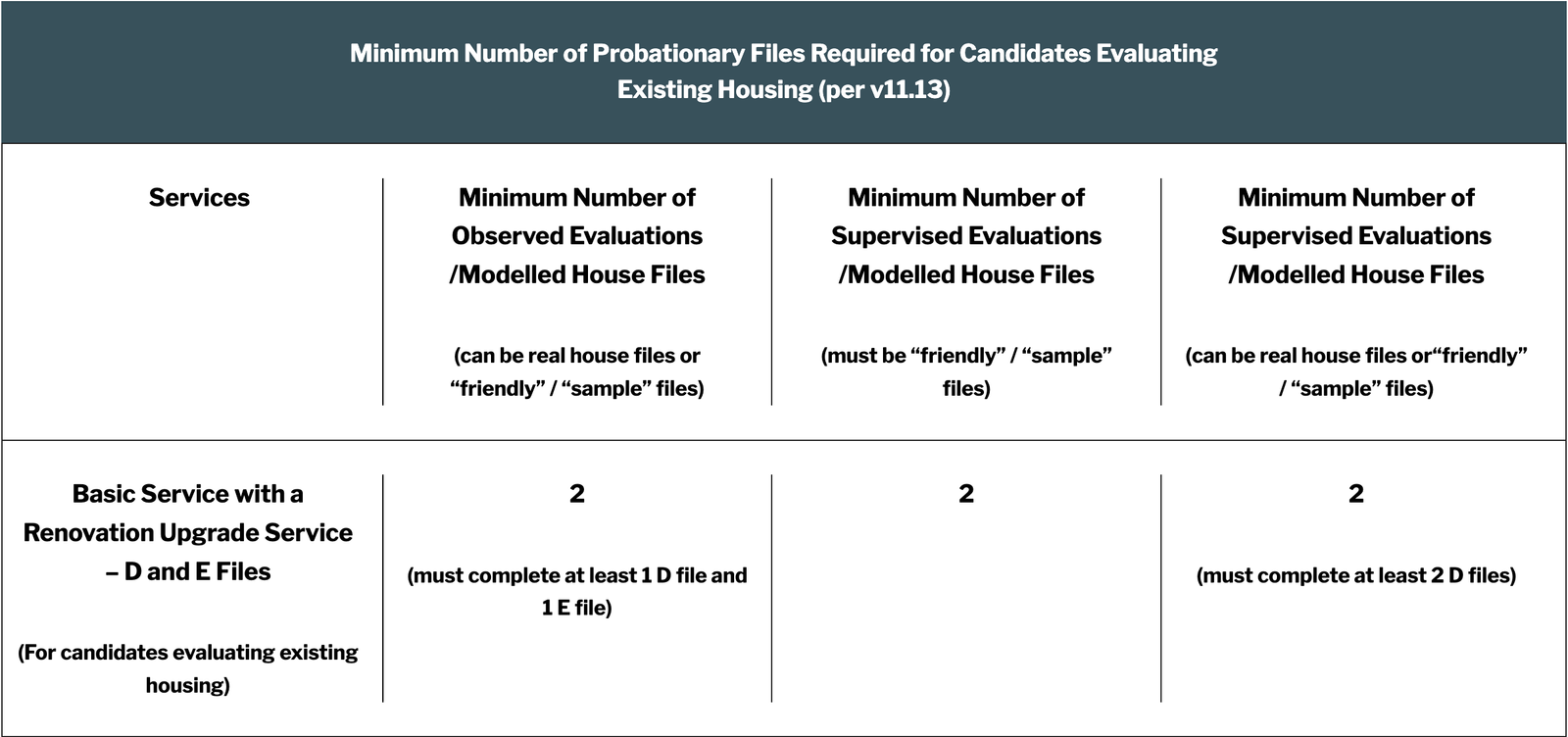
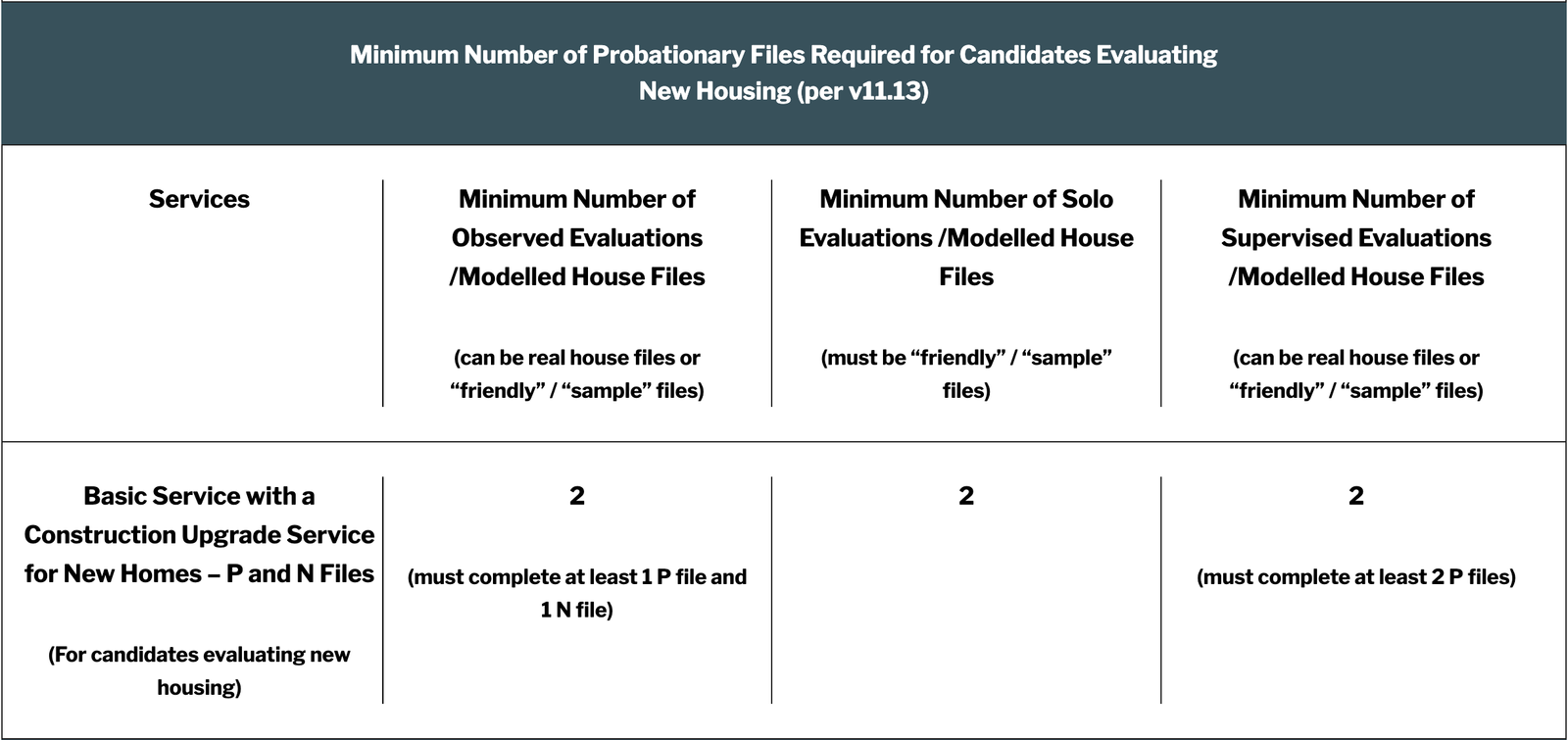
EAs must commit to either existing home or new construction audits for their probationary files and NRCan registration. A second probationary process is required to offer the other service. Please refer to the below chart.
Minimum Number of Probationary Files Required for Candidates Evaluating Chart
Minimum Number of Probationary Files Required for Candidates Evaluating
Existing Housing (per v11.13)
Services
Minimum Number of Observed Evaluations /Modelled House Files
(can be real house files or “friendly” / “sample” files)
Minimum Number of Solo Evaluations /Modelled House Files
(must be “friendly” / “sample” files)
Minimum Number of Supervised Evaluations /Modelled House Files
(can be real house files or“friendly” / “sample” files)
Basic Service with a Renovation Upgrade Service – D and E Files
(For candidates evaluating existing housing)
2
(must complete at least 1 D file and 1 E file)
2
2
(must complete at least 2 D files)
Minimum Number of Probationary Files Required for Candidates Evaluating
New Housing (per v11.13)
Services
Minimum Number of Observed Evaluations /Modelled House Files
(can be real house files or “friendly” / “sample” files)
Minimum Number of Solo Evaluations /Modelled House Files
(must be “friendly” / “sample” files)
Minimum Number of Supervised Evaluations /Modelled House Files
(can be real house files or “friendly” / “sample” files)
Basic Service with a Construction Upgrade Service for New Homes – P and N Files
(For candidates evaluating new housing)
2
(must complete at least 1 P file and 1 N file)
2
2
(must complete at least 2 P files)
Multi-unit residential buildings (MURBs)
If the Energy Advisor candidate intends to evaluate multi-unit residential buildings (MURB), the number of MURB probationary files, and type (observed, solo, supervised) required is to be determined at the discretion of the Service Organization, or the quality assurance specialist/experienced energy advisor overseeing the candidate’s probationary period. As part of their probationary period, the energy advisor candidate must demonstrate that they are capable of performing a multiple-zone blower door test. This can be demonstrated as part of an evaluation (probationary file) completed on a MURB that requires a multiple-zone blower door test, or as a simulation on another housing type where all components of the blower door test are exhibited as they would be in a MURB with multiple zones. By completing and submitting the Energy Advisor Registration and Activation Request Form, the service organization attests that the candidate meets this requirement and can conduct a multiple-zone blower door test. It is important to note that the candidate must also successfully pass the Energy Advisor Exam (MURB).
Multi-unit residential buildings (MURBs)
If the Energy Advisor candidate intends to evaluate multi-unit residential buildings (MURB), the number of MURB probationary files, and type (observed, solo, supervised) required is to be determined at the discretion of the Service Organization, or the quality assurance specialist/experienced energy advisor overseeing the candidate’s probationary period. As part of their probationary period, the energy advisor candidate must demonstrate that they are capable of performing a multiple-zone blower door test. This can be demonstrated as part of an evaluation (probationary file) completed on a MURB that requires a multiple-zone blower door test, or as a simulation on another housing type where all components of the blower door test are exhibited as they would be in a MURB with multiple zones. By completing and submitting the Energy Advisor Registration and Activation Request Form, the service organization attests that the candidate meets this requirement and can conduct a multiple-zone blower door test. It is important to note that the candidate must also successfully pass the Energy Advisor Exam (MURB).
Insurance Consideration
When applying for Errors and Omissions (E&O) insurance, it’s important that your provider understands the specific role and scope of work of an EA. Some general insurance providers—especially those you access through car or home policies—may misclassify EAs as consultants, engineers, or architects. This can result in significantly higher premiums due to the broader risk profiles of those professions.
To ensure proper classification and coverage at competitive rates, CACEA has partnered with Federated Insurance Company of Canada, a provider that understands the unique responsibilities and professional standards of EAs.
Understanding different insurance coverage
Errors and Omissions (E&O) Insurance
- Protects the Energy Advisor against claims of professional negligence, mistakes, or failure to deliver services as promised.
- Covers legal costs and damages if a client alleges that your advice, report, or assessment caused them a financial loss.
Example: If you provide an inaccurate energy model that leads to unexpected costs for the homeowner, E&O insurance would respond.
General Liability Insurance
- Covers third-party bodily injury, property damage, and related legal costs that occur during your normal business operations.
- Does not cover professional advice or consulting errors—it’s more about accidents.
Example: If you accidentally damage a client’s property during a blower door test, or someone trips over your equipment and gets injured, general liability insurance would respond.
Key Difference:
- E&O = Protects your professional work and advice
- General Liability = Protects against physical accidents or property damage caused while performing your work
➡ View our Affinity Program for full details and how to apply.
TIP for EA Candidates and New EAs
Before investing in expensive equipment—such as a blower door testing kit—consider borrowing or renting gear first. This allows you to gain experience and better understand what equipment best suits your needs before making a significant purchase. Visit the Marketplace or Member Forum or ask your SO.
Member Benefit:
CACEA members enjoy exclusive discounts on blower door equipment, infrared cameras, low-E detectors, and more.
Visit our Affinity Partners page for full details.
Once all steps are complete and approved, your SO will finalize your registration with NRCan, and you’ll officially be a registered EA.
Learning Happens in the Field
The real learning begins when you’re out in the field, working directly with clients. That’s when questions arise—and where experience meets growth.
A CACEA membership is your gateway to ongoing learning and support. Gain access to industry best practices and sharpen your skills through:
- Our interactive Member Forum
- On-demand webinar recordings
- Curated EA Resources
- Live and virtual educational events
Stay connected. Stay informed. Stay ahead.
EAs are required to rewrite an EA requalification exam through Yardstick every three years. Separate exams are required for additional MURBs and ENERGY STAR® for New Home licenses.
It is important to plan ahead to account for unforeseen delays due to technical or administrative issues or the need to rewrite an exam to ensure that the license does not expire.
Want to Learn More About How to Become an EA?
Visit the Natural Resources Canada website or contact a licensed SO in your region for training and mentorship opportunities.
We’re Here to Help
Why Join CACEA as a Trainee or Junior Member?
CACEA supports your EA journey with:
Start with a Trainee Membership and grow into a Junior or Full Member as you progress.